Tuesday, 3 January 2012

Breaking News

Breaking News


How To Get Your Sleep On Track After The Holidays

Posted: 03 Jan 2012 07:33 AM PST


Have trouble waking up this morning? You're not alone. The holidays are officially over -- and for many of us, it's back to work today.

"I think it's inevitable that we are going to have to pay the piper," says HuffPost blogger Rubin Naiman, Ph.D., sleep specialist and clinical assistant professor of medicine at the University of Arizona's Center for Integrative Medicine. "If we're stealing time from sleep, we're going to have to pay it back."

Those seemingly requisite holiday cheer activities, such as enjoying a day off work by sleeping in, drinking alcohol at a party, traveling to see family and ringing in the New Year at midnight Sunday morning, can really alter your circadian rhythms, making it difficult to readjust to waking up for normal everyday life.

"This is a kind of stationary jet lag," Naiman explains, where you have pushed your internal body clock ahead one, two or even three hours. "We're actually abruptly shifting to another time zone."

And so the interventions aren't unlike those you'd use to adjust to flying from California back to New York -- Naiman says the key is to use light or light substitutes in the morning and darkness or darkness substitutes in the evening to realign your body clock.

Soak up some bright light outside when you first wake up, suggests HuffPost blogger Russell Rosenberg, Ph.D., CEO of the Atlanta School of Sleep Medicine and chairman of the board of the National Sleep Foundation -- even better if you can combine some outdoor exercise. If going outside isn't possible, spend some time in front of an artificial light box. "That will help reset your clock, your circadian rhythms," he says.

During the day, reserve caffeinated beverages for the morning, and avoid them in the late afternoon and evening. "You don't want to start a vicious cycle of not being able to sleep," Rosenberg explains. And, if you work in a place where it's acceptable to grab a quick catnap, go for it (unless you suffer from insomnia, which can only make the problem worse).

At night, Rosenberg says not to worry if you can't snap back into an earlier bedtime right away. "What's really important is to set a regular wakeup time," he explains. "The bedtime will eventually reset itself." If you can't sleep after a few minutes, get up out of bed and do a non-stressful, non-work related activity. "Don't spend hours in bed wondering when sleep is going to happen. It perpetuates insomnia because you're over thinking it."

Rosenberg says your internal body clock should re-sync itself in a few days (if you have problems beyond that, you may want to speak with a doctor).

And Naiman underscores the importance of letting the readjustment happen slowly and naturally -- a "quick fix" of increased caffeine consumption during the day and alcohol and sleeping pills at night should not be the answer. "That can take a challenging situation and make it worse," he says. Instead, he recommends having faith in your body, and taking a small dose of melatonin between 15 and 30 minutes before you go to bed, if it helps.

"One of the things that I think is really important is to remember that the body and the brain are exquisitely resilient," he says. "We're built to take these kind of changes."

Iran Warns U.S. Against Sending Carrier to Gulf

Posted: 03 Jan 2012 07:28 AM PST


The head of Iran's army warned the U.S. against sending an aircraft carrier back to the Persian Gulf after it passed through the Strait of Hormuz a week ago.

"We usually don't repeat our warning, and we warn only once," Ataollah Salehi was cited as saying by the state-run Fars news agency. "We recommend and emphasize to the American carrier not to return to the Persian Gulf."

The USS John C. Stennis, which Iran said it spotted during naval exercises, passed eastward through the Strait of Hormuz on Dec. 27 on a routine voyage and was operating in the northern Arabian Sea, said the U.S. 5th Fleet, which has a base in Bahrain. Salehi spoke today at a ceremony to mark the completion of 10 days of maneuvers by the Iranian navy on the east side of the strait in the Gulf of Oman.

Iran will block oil shipments through the Strait of Hormuz if sanctions are imposed on its crude exports, as the U.S. and European Union have threatened, the state-run Islamic Republic News Agency said on Dec. 27, citing Vice President Mohammad Reza Rahimi. Navy Commander Habibollah Sayyari said the blockage would be "easy," according to the country's Press TV.

About 15.5 million barrels of oil a day, or a sixth of global consumption, passes through the Strait of Hormuz between Iran and Oman at the mouth of the Persian Gulf, according to the U.S. Energy Department.

The U.S. Navy said Dec. 28 that it won't tolerate a disruption to shipping in the strait.

Iran, the world's third-largest oil exporter, is facing new trade restrictions aimed at halting what the U.S. and allies say is a plan to build nuclear weapons. Iran says its atomic program is for peaceful purposes.

Inspectors from the International Atomic Energy Agency are expected to visit Iran soon, the Fars news agency cited Foreign Ministry

Barclays cuts Intel, Applied Materials to equal weight

Posted: 03 Jan 2012 07:26 AM PST

U.S. semiconductor stocks are in for a "volatile" 2012 as inventory correction extends into the first quarter, and an industry recovery due only in the second half, Barclays Capital said and downgraded five stocks, including Intel Corp.

Barclays lowered its ratings on Intel, Applied Materials Inc, Freescale Semiconductor Holdings Ltd, Microchip Technology Inc and Spansion Inc to "equal weight" from "overweight."

"First quarter should be the trough for semis given the ongoing inventory correction, coupled with supply chain constraints, due to muted end demand visibility," Barclays analyst C J Muse wrote in a note to clients.

Muse now expects U.S. semiconductor revenue growth to come in flat to 4 percent in 2012. He had earlier forecast growth of 2-5 percent.

According to Thomson Reuters' Starmine data, Muse is a four star-rated analyst for the accuracy of his earnings estimates on the companies under his coverage universe, which include Intel and Applied Materials.

Intel, which cut its fourth-quarter outlook citing hard drive shortages, will also see lower demand for its core PC business, Muse said.

Applied Materials is also likely to experience headwinds in its flat panel display and solar photovoltaic businesses, said the analyst.

Barclays' Muse sees volatility in the semiconductor space in 2012 with the emergence of new architecture, new computing platforms, expected refresh in operating systems, more players and the ongoing shortage in hard drives.

The analyst, however, expects semiconductor stocks to outperform end markets in the second half of 2012 and expects a 6-8 percent growth rate in 2013.

Barclays upgraded Cymer Inc, LSI Corp, Micron Technology Inc to "overweight" from "equal weight."

The Philadelphia semiconductor index fell 12 percent since the start of 2011 to end the year at 364.44 points, as the industry was hit by disruptions in supply chains with the earthquake and tsunami in Japan and flooding in Thailand.

Don't come back to Gulf, Iran warns US carrier; oil prices jump above $101

Posted: 03 Jan 2012 07:21 AM PST


TEHRAN: Iran's army chief on Tuesday warned an American aircraft carrier not to return to the Persian Gulf in Tehran's latest tough rhetoric over the strategic waterway, part of a feud with the United States over new sanctions that has sparked a jump in oil prices.

Gen. Ataollah Salehi spoke as a 10-day Iranian naval exercise ended near the Strait of Hormuz at the mouth of the Gulf. Iranian officials have said the drill aimed to show that Iran could close the vital oil passage, as it has threatened to do if the United States enacts strong new sanctions over Iran's nuclear program.

The strait, leading into the Gulf of Oman and Arabian Sea, is the only possible route for tankers transporting crude from the oil-rich states of the Persian Gulf to markets. A sixth of the world's oil exports passes through it every day.

Oil prices rose to over $101 a barrel on Tuesday amid concerns that rising tensions between Western powers and Iran could lead to crude supply disruptions. By early afternoon in Europe, benchmark crude for February delivery was up $2.67 to $101.50 a barrel in electronic trading on the New York Mercantile Exchange.

The jump came a day after Iran test-fired a surface-to-surface cruise missile as part of the maneuvers, prompting Iran's navy chief to boast that the strait is "completely under our control."

Salehi's warning for the US aircraft carrier not to come back seemed aimed at further depicting the strait and the Gulf as under Iran's domination, though there was little way to enforce his warning without military action. The strait is divided between Iran and Oman's territorial waters, and international law requires them to allow free passage through it.

"We recommend to the American warship that passed through the Strait of Hormuz and went to Gulf of Oman not to return to the Persian Gulf," Salehi was quoted as saying by the state news agency IRNA.

He said Iran's enemies have understood the message of the naval exercises, saying, "We have no plan to begin any irrational act but we are ready against any threat."

The aircraft carrier USS John C. Stennis and another vessel exited the Gulf through the Hormuz Strait a week ago, after a visit to Dubai's Jebel Ali port, according to the US Navy's Bahrain-based 5th Fleet. The Fleet did not immediately respond to requests for comment on Salehi's warning.

Iran's sabre-rattling over the strait and the Gulf has come in response to US preparations to impose tough new sanctions that would ban dealings with Iran's Central Bank. That would deeply hurt Iran's oil exports since most countries and companies use the bank to conduct purchases of Iranian crude. Iran relies on oil revenues for around 80 per cent of its budget, meaning a cut-off would be devastating to its already weakening economy.

President Barack Obama has signed the sanctions into law but has not yet enacted them. The sanctions would be the strongest yet by the US, aimed at forcing Tehran to back of its nuclear program, which many in the West say is intended to produce a nuclear weapon. Iran denies the claim, saying its program is peaceful.

French foreign minister Alain Juppe said on Tuesday that is country wants Europe to agree on similar sanctions against Iran by Jan 30 to show its determination to stop Iran from developing a nuclear weapon. He told the French television station i>TELE that there is "no doubt" that Iran is continuing with plans to build a bomb.

Iran's naval maneuvers took place over a 1,250-mile (2,000-kilometer) stretch of water beyond the Strait of Hormuz at the mouth of the Persian Gulf, as well as parts of the Indian Ocean and the Gulf of Aden, according to Iranian officials.

A leading Iranian lawmaker said on Sunday the maneuvers served as practice for closing the strait if the West enacts sanctions blocking Iranian oil sales. Top Iranian officials made the same threat last week.

Taliban say office in Qatar has been agreed

Posted: 03 Jan 2012 07:17 AM PST


The Afghan Taliban said Tuesday they have reached a preliminary agreement to set up a political office in the Gulf nation of Qatar, and asked for the release of prisoners held at the U.S. military prison in Guantanamo Bay.

The Taliban office is seen by Western and Afghan officials as a crucial step to moving forward with secretive attempts to reach a negotiated end to a decade of war in Afghanistan.

"We are right now ready ... to have a political office overseas, in order to have an understanding with the international (community), and in this regard we have reached an initial understanding with Qatar and relevant sites," spokesman Zabihullah Mujahid said in an emailed statement.

Afghanistan's high peace council said in late December Kabul would accept a Taliban liaison office in Qatar -- although Saudi Arabia and Turkey were Afghanistan's preferred choices -- but underlined that no foreign power could get involved in the negotiating process without its consent.

Senior U.S. officials told Reuters late last month that, after 10 months of dialogue with the Taliban, talks had reached a critical juncture and they will soon know whether a breakthrough is possible.

As part of the accelerating, high-stakes diplomacy, the United States is considering the transfer of several high-profile Taliban prisoners from the Guantanamo Bay military prison into Afghan government custody.

Mujahid also called for the release of Taliban prisoners.

"The Islamic Emirate has also asked for the release of the Guantanamo prisoners," the statement said, using the Afghan Taliban's own name for its movement.

Afghanistan's leaders have expressed concerns that any office be used only as an address to help negotiators verify the identity of anyone claiming to represent the Taliban, rather than as a base to build political clout.

The call for an address came after a series of failed efforts by Afghans and their Western allies, some of them with interlocutors who turned out to be frauds.

These culminated in the September, 2010, assassination of Karzai's top peace envoy by a man accepted as a Taliban representative, which appeared to destroy the president's appetite for negotiations, but he has recently renewed his support.

Egyptians head to polls again in parliament vote

Posted: 03 Jan 2012 07:15 AM PST


Party agents flooded the streets with banners and verses from the Koran as the third phase of Egypt's parliamentary election began on Tuesday, with Islamists trying to dominate an assembly that will rival the clout of the ruling generals.

The army faced anger over its handling of protests that left 17 people dead in Cairo last month and an economic crisis has made it harder to meet the aspirations of citizens yearning for a better life since the overthrow of President Hosni Mubarak.

In an industrial region north of Cairo where labor disputes over low wages preceded the wider protests that brought down Mubarak, optimism was high as residents lined up to vote.

"I am glad to be alive to witness this - a free election in Egypt," said Ahmed Ali al-Nagar, a carpenter in his late 50s from Mahalla el-Kubra. "Workers had a big impact on the political outcome we are living through these days."

Islamists came late to the uprising that unseated Mubarak in February, but were well placed to seize the moment when Egyptians were handed the first chance in six decades to choose their representatives freely.

The military says the parliamentary vote will not be derailed by the eruptions of violence.

The Muslim Brotherhood's Freedom and Justice Party (FJP) led after the first two rounds, and the strong showing by Islamist movements has sown unease among Western powers that only disowned Mubarak when his three-decade rule was crumbling.

Many citizens see the first fair election they can remember as a chance to end the blight of incompetent leadership and a culture of venality among the powerful that enriched a few and left millions in poverty.

The concluding vote to parliament's lower house takes in regions of the rural south, which has the largest proportions of Christian voters, the Nile Delta region north of the capital Cairo, and the restive Sinai desert region to the east.

Turnout has been far higher and the election atmosphere less tense than in Mubarak's day, when ballot stuffing, thuggery and vote-rigging guaranteed landslide wins for his party.

In Mahalla and the wealthier city of Mansoura, queues at polling stations were shorter than in previous rounds but voting appeared orderly.

Streets were dotted with the posters of parties, especially the Brotherhood and hardline Islamist al-Nour party, promising an end to corruption.

"I have chosen to vote for the Freedom and Justice Party as I like its talk and I think it has a long history and experience and I think they will help us the most," said Amany al-Mursy, a smiling middle-aged woman from Mansoura.

"And if it does not do as we hoped, Tahrir Square is still there. If something goes wrong, we will go out and say something is wrong and remove the wrong people and replace them."

POLICE RAID VOTE MONITORS

Egyptians turned out in unprecedented numbers in the first two rounds and parties ranging from hardline Islamists to liberals and secularists are competing hard for every vote.

Brotherhood banners in Mahalla carried its motto "Islam is the solution" alongside its FJP party logo, in defiance of a ban on religious slogans. In Minya in the rural south, some campaign banners carried verses from the Koran.

Flyers for the hardline Islamist al-Nour party carried names of influential families who had lent their support. Nour drew on the grass-roots influence of the Salafi clerics who founded it to take second spot in the first voting rounds.

Monitors praised the first two rounds as relatively free of irregularities, while noting that many parties had defied a ban on campaigning outside polling stations in election day.

But police raids on pro-democracy and rights groups last week have disrupted the work of leading Western-backed election monitors and drawn accusations that the army was deliberately trying to weaken oversight of the vote and silence opponents.

The government said the raids were part of an investigation into illegal foreign funding of political parties and not aimed at weakening rights groups, which have been among the fiercest critics of the army's rule.

The United States called on Egyptian authorities to halt "harassment" of the groups involved. Egypt's government said some of the groups had no permits to operate in the country.

The U.S.-funded International Republican Institute (IRI) said it was invited by Egypt's government to monitor the election and gave no funding to parties or civic groups.

It urged the government to let staff return to their offices and obtain the official permits they had long requested and said there was no reason to stop it monitoring the vote.

Another U.S.-backed group, the National Democratic Institute (NDI), said it was pressing ahead with monitoring even though police had not returned equipment, documents and money they seized without providing a warrant or an inventory.

"NDI hopes that the confiscated items will be returned promptly," it said, so the group can "resume a constructive dialogue with the appropriate authorities about its work and legitimate efforts to support the democratic process in Egypt."

Fourteen million eligible voters in nine regions were choosing who occupies 150 of the seats in parliament. The staggered lower-house election concludes with a run-off vote on January 10 and 11, with final results expected on January 13.

women terrorists

Posted: 03 Jan 2012 07:12 AM PST

NEW DELHI: The Lashkar-e-Taiba is raising a group of 21 female terrorists at its training camps in Pakistan-occupied Kashmir for carrying out sabotage activities in India, Army sources said on Tuesday.

"We have confirmed reports that LeT is imparting training to 21 selected female terrorists at its training facilities in Muzaffarabad in PoK for carrying out terrorist activities in India," an Army official said here.

They said the new group, named as Dukhtareen-e-Taiba, is planned to be made active in the Kashmir Valley by the LeT.

In the recent past also, reports have suggested presence of female terrorists operatives in the 42 active terror training camps in PoK.

The women terrorists are planned to be infiltrated into India through routes in Uri sector or using the aerial route through some other country.

Sources said the raising of the female terror group was brainchild of LeT senior functionary and mastermind of Mumbai terror attacks Zakiur Rehman Lakhvi.

They said the terror group has suffered serious setbacks in Jammu and Kashmir with the elimination of their top leadership by the security forces.

They are also working on recruiting local youth in certain areas of the state, including Pulwama, to expand terror network and the task has been assigned to a person, Usman Bhai alias Chhota Rehman, they said.

Meteor shower to kick off 2012

Posted: 03 Jan 2012 07:06 AM PST


The Quadrantids, named for a now-extinct constellation, will be visible for two hours early Wednesday, from about 3 to 5 a.m. local times.

The shower is likely to produce up to 100 falling stars an hour, making for a good show. People across North America who stay up late enough, and who have a clear sky, should get a nice view, says Conrad Jung, an astronomer at Chabot Space and Science Center in Oakland.

Other than typical January temperatures, the weather should cooperate for watchers: "Viewing should be great over most of the country," reports Weather Channel meteorologist Mark Ressler. The only potentially cloudy spots should be in the Pacific Northwest, the Great Lakes and parts of the Northeast, he says.

It's possible that the East may get a more intense shower because it will go through the densest part of the debris stream first. "But that doesn't mean the West won't see anything," he says.

"There should be a meteor every minute or so at the very least," he says.

The shower is called the "Quads" by astronomers, says Bill Cooke, who tracks "space rocks" as director of NASA's Meteoroid Environment Office at Marshall Space Flight Center in Huntsville, Ala. "They're one of the more active meteor showers of the year, but they're not seen by many people" because they occur in early morning hours in winter, he says. "It's very cold around that time, so people don't want to go outside."

The Quadrantids are also less seen because they're short-lived and relatively little is known about them, he says. The Quadrantids are visible for two hours, then are gone for a year.

The meteors will be coming out of the northern portion of the sky, between a somewhat obscure constellation called Boötes and the handle of the Big Dipper.

As for the somewhat odd name of Quandrantids, it's pronounced Quad-RON-tihds, Jung says. Its name comes from a so-called extinct constellation called the Quadrans Muralis. That doesn't mean the stars have disappeared, only that it's a constellation that's no longer recognized by the International Astronomical Union. It fell by the wayside in the early 20th century, when the constellations were formalized, Jung says.

The shower comes from the remnants of a comet named 2003EH1, which probably broke up in the past 500 years. The tiny particles of rock that remain will enter Earth's atmosphere at 90,000 mph, burning up 50 miles above the surface and creating the falling stars that gazers will see.

"It's possible that 2003EH1 was seen by the Chinese back in the 1490s as a comet, so something the Chinese saw over five centuries ago is probably the parent of the Quadrantids," Cooke says.

Authorities probe cause of Florida women's clinic blaze

Posted: 03 Jan 2012 07:04 AM PST


Accelerant-sniffing dogs will be at a Pensacola, Florida, women's clinic Tuesday as authorities work to determine the cause of a blaze early Sunday that caused extensive damage to the building, officials said.

"We have determined the fire originated outside the building, but haven't determined the exact cause," said Deborah Cox, spokeswoman for the Florida State Fire Marshal's office.

Agents from the FBI and the federal Bureau of Alcohol, Tobacco, Firearms and Explosives have joined local authorities in the investigation into the fire at the American Family Planning clinic, Cox said.

Over work

Posted: 03 Jan 2012 07:00 AM PST

two persons who are working 18 hour a day!
VEENA Malik 


 AND

Rahman Malik


This statement was given by a famous politician of pakistan

Stephen Lawrence murder: Dobson and Norris found guilty

Posted: 03 Jan 2012 06:52 AM PST


Two men have been convicted of the racist murder of black teenager Stephen Lawrence - 18 years after the attack.

Gary Dobson, 36, and David Norris, 35, were found guilty by a jury at the Old Bailey after a trial focused on forensic evidence seized in 1993.

Scientists found a tiny blood stain on Dobson's jacket that could only have come from Mr Lawrence.

As he was led down, Gary Dobson told the jury they had condemned an "innocent man".

Stephen's parents, Doreen and Neville, wept in court as the jury found both men guilty. Duwayne Brooks, Stephen's best friend who had been with him on the night of the murder, tweeted: "Some justice at last".

The original failed investigation led to the Metropolitan Police being branded as institutionally racist.

Stephen Lawrence was 18 when he was stabbed to death near a bus stop in Eltham, south London, in April 1993. Police identified five men who were later named in a damning public inquiry as the "prime suspects".
Continue reading the main story
18 YEARS ON: THE EVIDENCE

    Tiny blood stain on Dobson's jacket
    Scientists found DNA and matched it to Stephen
    Clothing fibres matched victim's clothes
    Single 2mm hair matched to teenager

By that time there had already been a catalogue of police errors and two failed prosecutions, one brought by Stephen's parents, Doreen and Neville Lawrence.

But in a four-year-long cold case review, a fresh team of forensic scientists uncovered microscopic evidence linking the men to the murder - evidence that the police had held all along.

The material - blood stains, clothing fibres and a single hair belonging to the teenager - were recovered from the clothes of the suspects which had been seized in 1993.

Scientists recovered the material using advanced techniques which were not available to the original case scientists.

Dobson and Norris, who denied the murder, said their clothing had been contaminated as police mixed up evidence down the years. Detectives spent months establishing the movements and handling of the exhibits since 1993 - and the jury were told that contamination was implausible.

Gary Dobson, jailed in 2010 for drugs trafficking, is among a small number of men to have been tried twice for the same crime after the Court of Appeal quashed his 1996 acquittal for the murder.


In an exclusive interview with the BBC's Panorama, Stephen's mother Doreen Lawrence said: "I don't forgive the boys who killed Stephen. They don't think they have done anything wrong.

"They took away Stephen's life and there is nothing in their behaviour or anything to show they they regret what their actions have done and the pain it has caused us as a family."

Acting Assistant Commissioner Cressida Dick, who ordered the 2006 cold case review that led to the convictions, said the case had been extremely important for the Lawrence family, the Metropolitan Police and society at large.

She said: "It has been a unique case in policing. Firstly the horrible, horrible nature of the attack on the night. The time in which it has taken to bring anybody to justice and the tireless campaigning of the Lawrences.

"There is no comparable case. All homicide cases are terrible, but for us it is a very important case. Most importantly we wanted to be able to bring people to justice for the killing and try to give Doreen and Neville Lawrence and their family some sense of justice."

Taliban back Western proposal to open Qatar office

Posted: 03 Jan 2012 06:48 AM PST
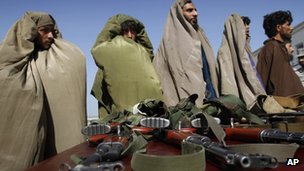

The Taliban say they have reached a preliminary agreement to set up a political office, possibly in Qatar, as part of Western plans to end the war.

A statement confirmed the move, which has been backed by Afghan President Hamid Karzai.

Both the US and Germany have been pushing for such a representation in an effort to kick-start negotiations.

The office is seen by some as a key step towards ending the 10-year-long conflict in Afghanistan.

The move was welcomed by the Afghan High Peace Council, which is seeking a negotiated end to the war, as "a gesture of good faith".

But it still remains unclear if the insurgents, who claim to be winning the war, are prepared to engage in truly meaningful peace talks - and whether they could take place while international forces continue to kill Taliban fighters and commanders, says the BBC's Quentin Sommerville in Kabul.
Importance of address

In their statement, the insurgents said Afghanistan's "current problem" began with the US-led invasion of 2001 and "the two main sides which were involved in this are the Islamic Emirate of Afghanistan [Taliban] and on the other side is the United States and their foreign allies".
Continue reading the main story
Analysis
image of Quentin Sommerville Quentin Sommerville BBC News, Kabul

The establishment of an office is thought by some to be a critical step in reaching a political settlement to the 10-year long conflict. It would give the group an address where negotiators could meet. Establishing the authenticity of would-be negotiators from the Taliban has been a problem in the past.

It is the US and Germany that have been pushing for this. Earlier preconditions that the insurgents would have to lay down arms before any such representation appear to have been dropped. The push for a peace process, with a reluctant President Karzai falling in line, appears to be under way.

Some senior military commanders here say that the Bonn conference, where the international community gave a long-term commitment to Afghanistan, was a wake-up call for the insurgents. They face the prospect of growing old, as exiles, in the Pakistani city of Quetta, commented one senior Isaf commander.

But it is far from certain that the Taliban truly want to negotiate. They know foreign troops are leaving in 2014. And there will be reluctance from some within the group's leadership to sit down and talk with representatives from countries who are killing Taliban soldiers and commanders.

It said the Taliban movement "always tries to solve the issue or the problem with the opposite side through talks" and warned the Western coalition that they would "never force the Afghans to obey them by force".

"For the sake of a better understanding with the internationals, we have an initial understanding to have a political office - including in the country of Qatar."

The statement added that they wanted prisoners released from the US-run detention centre in Guantanamo Bay, as part of a deal.

And it also rejected as false reports by "Western press and officials" about negotiations.

The agreement to set up the liaison office would give the group an address where negotiators could meet, says our Kabul correspondent, and some see this agreement as a critical step.

Establishing the authenticity of would-be negotiators from the Taliban has been a problem in the past.

Last month, President Karzai gave his first public support to the plan - having previously rejected the idea, angry that the US and Germany had discussed potential locations without him.

Kabul has repeatedly stressed that it will not accept any foreign intervention in negotiations with the Taliban.

Efforts to hold talks have been hit by a string of setbacks, including the assassination in September of Burhannudin Rabbani, the head of the peace council, which had been liaising with the militant group.

The Taliban denied being responsible, but said the attack added to the sense of mistrust.

A senior negotiator on the council, Arsala Rahmani, said the Taliban needed to be in touch with the international community.

We welcome their decision to set up a political office," he told Reuters news agency.

"It is a gesture of good faith. The Taliban are blacklisted by the US so it is very important for them to engage in talks with the US."

US and Afghan officials have also stressed that Pakistan - where the Taliban's leadership are believed to be based - must be involved in the process.

Iran threatens U.S. Navy as sanctions hit economy

Posted: 03 Jan 2012 06:45 AM PST


Iran threatened Tuesday to take action if the U.S. Navy moves an aircraft carrier into the Gulf, Tehran's most aggressive statement yet after weeks of saber-rattling as new U.S. and EU financial sanctions take a toll on its economy.

The prospect of sanctions targeting the oil sector in a serious way for the first time has hit Iran's rial currency, which has fallen by 40 percent against the dollar in the past month.

Queues formed at banks and some currency exchange offices shut their doors as Iranians scrambled to buy dollars to protect their savings from the currency's fall.

Army chief Ataollah Salehi said the United States had moved an aircraft carrier out of the Gulf from because of Iran's naval exercises, and Iran would take action if the ship returned.

It did not name the carrier, but the USS John C Stennis leads a task force in the region, and the U.S. Navy's 5th Fleet website pictured it in the Arabian Sea last week.

"Iran will not repeat its warning ... the enemy's carrier has been moved to the Sea of Oman because of our drill. I recommend and emphasize to the American carrier not to return to the Persian Gulf," army chief Salehi said.

"I advise, recommend and warn them over the return of this carrier to the Persian Gulf because we are not in the habit of warning more than once."

Lieutenant Rebecca Rebarich, spokeswoman for the U.S. 5th Fleet based in Bahrain, said she was not immediately able to respond.

Tehran's threat comes at a time when sanctions are having an unprecedented impact on its economy, and the country faces political uncertainty with an election in March, its first since a 2009 vote that triggered countrywide demonstrations.

The West has imposed the increasingly tight sanctions over Iran's nuclear program, which Tehran says is strictly peaceful but Western countries believe aims to build an atomic bomb.

After years of sanctions that had little impact, the latest measures are the first that could have a serious effect on Iran's oil trade, 60 percent of its economy.

New sanctions signed into law by U.S. President Barack Obama on New Year's Eve would cut off any financial institutions that work with Iran's central bank from the U.S. financial system, blocking the main path for payments for Iranian oil.

The EU is expected to impose new sanctions by the end of this month, possibly including a ban on oil imports.

Even Iran's top trading partner China - which has refused to back new global sanctions against Iran - is demanding discounts to buy Iranian oil as Tehran's options narrow. Beijing has cut its imports of Iranian crude by more than half for January and, paying premiums for crude from Russia and Vietnam to replace it.

THREATS

Iran has responded to the tighter measures with increasingly belligerent rhetoric.

It spooked oil markets briefly when it announced last month it could prevent shipping through the Straight of Hormuz - a narrow shipping lane through which flows 40 percent of the world's oil trade - if sanctions hurt its own oil business.

It then held 10 days of naval exercises in the Gulf, test firing long range missiles that could hit Israel or U.S. bases in the Middle East. But Tuesday's apparent threat to take action against the U.S. military for sailing in international waters takes the aggressive rhetoric to a new level.

The new U.S. sanctions law, if implemented fully, would make it impossible for many refineries to pay Iran for crude. It imposes measures gradually and allows Obama to offer temporary waivers to prevent an oil price shock.

The European Union is expected to consider new measures by the end of this month, possibly including a blockade. EU members such as such as crisis-hit Greece are still buyers of Iranian oil, which trades at a discount.

French Foreign Minister Alain Juppe said Paris wants new measures taken by January 30, when EU foreign ministers meet.

"France ... wants sanctions toughened and the president (Nicolas Sarkozy) has made two concrete proposals on that front - the first being the freezing of Iranian central bank assets, a tough measure, and the second an embargo on Iranian oil exports," Juppe told i>tele, a French TV channel.

Michael Mann, spokesman for EU foreign policy chief Catherine Ashton, said member states would discuss the issue this week in the hope of reaching an agreement on new steps before the January 30 meeting.

"The ball is still in the Iranians' court," he said.

Although China, India and other countries are unlikely to sign up to any oil embargo, they will be able to insist on deeper discounts, potentially reducing the income Tehran receives from oil.

Beijing has been driving a hard bargain. China, which bought 11 percent of its oil from Iran during the first 11 months of last year, has cut its January purchase by about 285,000 barrels per day, more than half of the close to 550,000 bpd that it bought through a 2011 contract.

The impact of falling government income from oil sales can be felt on the streets in Iran in soaring prices for state subsidized goods and a falling rial currency.

Some exchange offices in Tehran, when contacted by Reuters, said there was no trading taking place until further notice.

"The rate is changing every second ... We are not taking in any rials to change to dollars or any other foreign currency," said Hamid Bakshi in central Tehran.

Housewife Zohreh Ghobadi, waiting in a long line at a bank, said she was trying to withdraw her savings and change it into dollars.

Iranian authorities played down any link between the souring exchange rate and the imposition of the new sanctions.

"The new American sanctions have not materialized yet," Foreign Ministry spokesman Ramin Mehmanparast told a news conference Tuesday. "It will take a few months until these sanctions are fully implemented."

The economic impact is being felt ahead of a nationwide parliamentary election on March 2, the first vote since a disputed 2009 presidential election that led to the worst unrest since Iran's 1979 revolution.

Tight race in Iowa kicks off 2012 campaign

Posted: 03 Jan 2012 06:39 AM PST


Iowa Republicans cast the first votes of the 2012 White House campaign on Tuesday, with Mitt Romney, Rick Santorum and Ron Paul in a high-stakes battle to win the party's kick-off nominating contest.

Voters will gather in schools, libraries and other public spots across the state to render judgment in the frequently shifting Republican race to pick a challenger to President Barack Obama in the November 6 election.

Santorum, a conservative former senator from Pennsylvania, is the latest candidate to rise in polls in a race that has seen a handful of hopefuls roll through the top spot.

He is battling Romney, the national front-runner and narrow leader in Iowa polls, and libertarian Paul for a crucial win in Iowa that could provide momentum and a surge of new donations as the race moves to next week's contest New Hampshire.

"Get folks and bring them to the caucus with you," Santorum told supporters in Perry, Iowa, on Monday as each of the candidates made a final pitch for votes and tried to bolster their turnout.

Iowa polls showed many voters could still change their mind before Tuesday night, adding an element of unpredictability to an already fluid race.

"I'm undecided, and I'm still in the same boat as when I came," said Zander Morales, a hospital worker in Des Moines after he attended a rally on Monday for Paul, the congressman from Texas. "I'm not sure what I'm going to do."

Republican voters in Iowa gather for the caucuses at more than 800 sites across the state beginning at 7 p.m. EST. Results should begin to come in within a few hours.

The event is the culmination of months of campaigning in Iowa, and starts a frenzied schedule that will include a half-dozen debates in January and three more state contests -- on January 10 in New Hampshire, January 21 in South Carolina and January 31 in Florida.

GANGING UP ON SANTORUM

The stakes are high for each of the six candidates competing in Iowa. Romney, the former governor of Massachusetts, is aiming for a win that could ease persistent conservative doubts about his record and propel him toward clinching the nomination early.

Struggling rivals like Texas Governor Rick Perry and Representative Michele Bachmann are fighting for at least a fourth-place finish that could keep their flickering White House hopes alive.

And Newt Gingrich, the former House speaker who led the race just weeks ago, aims to end his slide and prove he can make a comeback.

Santorum was trying to consolidate fractured religious and social conservatives in Iowa and emerge as the leading conservative alternative to Romney.

But Perry, Paul and Romney criticized Santorum for backing costly spending bills when he served in the Senate, hoping to halt his rise in the final hours of the campaign.

"He spends too much money," Paul told CNN.

Iowa's nominating contest has a spotty track record of picking winners, but has traditionally cleared the presidential field of losers and elevated surprise contenders.

Polls show Romney performs best of all the Republicans in head-to-head matchups with Obama in a general election campaign certain to focus on the economy and high unemployment.

But some voters in Iowa were torn between their urge to reclaim the White House from Obama and their search for a candidate who best meets their conservative principles.

Santorum supporter Peggy Greenfield of Clive, Iowa, said she was drawn by his "consistent family values" and foreign policy knowledge.

"When people see the momentum he has going it gives them the courage to go out and caucus for him," she said.

Monday, 2 January 2012

Breaking News

Breaking News


Shaheen Tae-Kwon-Do Academy.mp4

Posted: 02 Jan 2012 08:05 AM PST

baby dance.mp4

Posted: 02 Jan 2012 07:55 AM PST

British Darth Vader fighter dies aged 89

Posted: 02 Jan 2012 07:36 AM PST


Former Olympic fencer Bob Anderson, who staged fights in Star Wars and From Russia With Love, has died at the age of 89.

Anderson fought light saber battles as Darth Vader in The Empire Strikes Back and Return of the Jedi, two of the original Star Wars films.

In the non-fight scenes, Vader was played by David Prowse and voiced by James Earl Jones.

The British Academy of Fencing confirmed Anderson died on 1 January.

It was Mark Hamill, who played Luke Skywalker in the Star Wars trilogy, who revealed Anderson was behind the fight scenes in a 1983 interview with Starlog magazine.

"It was always supposed to be a secret, but I finally told George (Lucas) - the director - I didn't think it was fair any more," he said.

"Bob worked so bloody hard that he deserves some recognition. It's ridiculous to preserve the myth that it's all done by one man."

Robert James Gilbert Anderson was born in Hampshire in 1922. He served in the Royal Marines during World War II and represented the UK in fencing at the 1952 Olympics and the 1950 and 1953 World Championships.

His first foray into the film world was in the 1952 swashbuckler The Master of Ballantrae, starring Errol Flynn.

He was soon in demand and went on to work on films including Die Another Day, The Princess Bride, The Legend of Zorro and The Lord of the Rings trilogy.

Fencing Academy president Philip Bruce paid tribute on its website: "He was truly one of our greatest fencing masters and a world-class film fight director and choreographer and both the fencing community and film world will miss him."

Anderson is survived by his wife Pearl and three children. Funeral details have not yet been announced.

Up to 50,000 flee South Sudan tribal turmoil: U.N.

Posted: 02 Jan 2012 07:34 AM PST

Up to 50,000 people have fled tribal violence in a remote border area of South Sudan, the United Nations said Monday, in the latest episode of upheaval to hit the new African nation.

South Sudan became independent in July last year under a 2005 peace deal with Khartoum to end decades of civil war. But the new nation is struggling to build state institutions and stop rebel and tribal bloodshed that has killed thousands.

Monday, some 6,000 armed members of the Lou Nuer tribe attacked the remote town of Pibor in Jonglei state bordering north Sudan after days of clashes with the rival Murle tribe, U.N. sources said.

Lise Grande, U.N. humanitarian coordinator for South Sudan, said tens of thousand of civilians had fled Pibor and other nearby towns to escape the violence.

"We are worried about their conditions. They are without water, shelter and food. They are hiding in the bush. I think it is between 20,000 and 50,000. This is an estimate only," she told Reuters. She had no information about casualties.

South Sudan's armed forces are sending reinforcements to Pibor, army spokesman Philip Arguer said. "They attacked the town this morning. Civilians were evacuated from Pibor three days ago," he said, without giving further details.

U.N. sources said around 3,000 soldiers and 800 policeman were on their way to Pibor. Cattle raids, they said, had sparked the latest violence.

Left rages as Sarkozy finds best friend in crisis

Posted: 02 Jan 2012 07:31 AM PST


With the French economy tanking, President Nicolas Sarkozy is pursuing an unorthodox campaign strategy: depict the crisis as so bad and so global that his untried opponents could not deal with it, and hope the picture holds until election time.

The list of French problems - from record-high unemployment to bleak growth prospects, the threat of a rating downgrade and increasingly wobbly-looking deficit-reduction plans - would have many leaders in preservation mode, seeking to limit damage.

But Sarkozy has taken a different tack, seizing in a December 31 speech on fears over an economic crisis he described as "planetary," "unprecedented" and "the worst since World War 2."

The opposition Socialists, whose challenger for the April 2012 presidential election, Francois Hollande, has a clear lead over Sarkozy in opinion polls, criticized it as an underhand way of masking his failures while capitalizing on public anxieties.

"There was an admission of weakness," Manuel Valls, a spokesman for Hollande, said after Sarkozy's speech. "This is Nicolas Sarkozy's approach ... it's to play on fears and fears of the crisis."

Analysts say Sarkozy's underlying message was that without his leadership, France would be in a far worse position than now, given the unprecedented global nature of the crisis in which France's problems are only a symptom.

For opponents, the implication is that they are not strong or seasoned enough to lead France through the storm.

Pascal Perrineau, a political analyst, summed up the strategy in a comment to Les Echos daily: "If the crisis is bad, Sarkozy is beaten; if the crisis is very bad, he is elected."

Valls maintained that Sarkozy had brought France to the brink of recession. "We've got a million more people unemployed since his five-year term began," he told a news conference.

Sarkozy vowed in his New Year's speech to use a January 18 meeting with unions, just three months before election day, to come up with some kind of agreement on improving labor market flexibility as a way to stem unemployment.

But Socialists sniffed at his chances of achieving reform so close to the election.

"I don't think anyone is fooled, everyone knows he is a candidate and everyone knows that you cannot do in four months, on jobs, unemployment and job security, what he did not do in the first four years of his presidency," said Valls.

In his New Year address, a solemn Sarkozy urged the French to be stoical as he called for a new tax on imported goods to help shore up a welfare system which now relies mostly on social fees taken out of workers' paychecks.

"The strategy we've been pursuing for the past 20 years is to cut labor costs to be more competitive. Has that produced any salary increases until now? No. Will it increase salaries in a crisis? Obviously not," said Socialist Party spokesman Benoit Hamon.

Jean-Luc Melenchon, head of the hardline Left Party, called Sarkozy's initiative a "bad joke."

"If we want to avoid firms moving away, we need to stop companies moving abroad to profit from 'social dumping', by which products cost less abroad because work is less paid and produced in awful environmental conditions," he told France Info radio.

Look for These 3 Law School Trends in 2012

Posted: 02 Jan 2012 07:29 AM PST


You likely made a New Year's resolution or two yesterday, vowing to eat healthier, exercise more, or spend less money.

Across the country, law schools are making big plans for 2012, too.

There are three emerging trends in legal academia that have slowly gained traction over the past few years and will likely dominate much of the discussion surrounding law schools in the coming year. So as we ring in the new year, what are some factors law schools should keep in mind when making their resolutions—and what will they mean for law students?

1. Accelerated law programs: Law schools are responding to student concerns about the time and cost (both in terms of tuition and the opportunity cost associated with foregoing a salary for three years) required to complete a law degree. As a result, a number of schools have developed accelerated programs that allow students to complete law school in two rather than three years.

Northwestern Law School is currently the only top 14 law school to have a two-year program, but other top schools have considered such programs. (Southwestern Law School and the University of Dayton School of Law offer similar programs, too.) I expect a number of leading law schools to follow Northwestern's lead in the coming months and years.

As accelerated law programs multiply, you may consider taking advantage of one of these options—but they are not for everyone. While the cost savings can be enticing, you have to be sure that you are prepared for the academic challenges.

Northwestern, for example, requires that applicants to its accelerated J.D. program have at least two years of "substantive" work experience to ensure students will be able to handle the rigor of the fast-track program. Another potential disadvantage to seriously consider is missing valuable summer internship opportunities, which often lead to full-time jobs.

[Law jobs exist where students don't look, one dean says.]

Accelerated combined degree programs are also rapidly gaining popularity. For example, students can now complete J.D./M.B.A. programs at the University of Pennsylvania Law School, Northwestern Law School, Yale Law School, and Duke Law School in three years instead of the traditional four years. Yale Law School's Accelerated Integrated J.D./M.B.A. is unique in that it keeps students' summers free for internships, avoiding a typical drawback of accelerated programs that require students to take classes during the summer.

2. Debate over the LSAT: In recent years, there has been increased debate regarding the fairness of the LSAT and its ability to accurately predict one's aptitude for practicing law. While even opponents of the LSAT acknowledge that there is a strong (though certainly not perfect) correlation between one's LSAT score and one's law school GPA, they believe that the test and the current law school grading paradigm do not most accurately evaluate the skills required for professional success in the legal arena.

The most outspoken challengers of the LSAT are University of California—Berkeley Law School professors Marjorie Shultz and Sheldon Zedeck, who advocate replacing the LSAT with a new test that better measures an applicant's potential for success in the practice of law.

There are an increasing number of schools—though still a very small minority—that have received exemptions allowing them to admit students without LSAT scores, which is typically a requirement for law school accreditation. For example, Northwestern's J.D./M.B.A. program allows students to be admitted with a GMAT score in lieu of an LSAT score.

[Find out how to study for the GMAT.]

The concerns of Professors Shultz and Zedeck about the LSAT are legitimate and do need to be addressed. Nevertheless, until an alternative metric that can be applied to all students and equally (or hopefully better) predicts law school success is available, we are unlikely to see the LSAT disappear.

3. Fewer law school applicants: The number of people taking the LSAT was down 9.6 percent in 2010-2011 (155,050) from 2009-2010 (171,500), according to LSAC. Preliminary year-end numbers for 2011 show a similar trend in law school applications, which have decreased 9.9 percent, down to 78,900 from 87,500 in 2010.

For the last five years, law school admissions have been extraordinarily competitive due to the stagnant economy. A decline in the number of applicants is welcome news, as it means that the competition may be slightly less fierce this year. However, current law school application levels are still very high by traditional standards, so gaining admission to the top 14 schools will remain very challenging

UK's Cameron to tackle "excess" City pay

Posted: 02 Jan 2012 07:25 AM PST


Britain's Prime Minister David Cameron said on Monday he would clamp down on "excess" pay in London's financial sector as part of what he said should be bold measures to boost the country's fortunes.

"While a few at the top get rewards that seem to have nothing to do with the risks they take or the effort they put in, many others are stuck on benefits, without hope or responsibility," he said in a New Year message.

"So we will tackle excess in the City just as we're reforming welfare to make work pay and support families."

Cameron said the London Olympics and Queen Elizabeth's Diamond Jubilee later this year would provide an "extraordinary incentive" to restore pride in the country's abilities.

But he also said many people were worried about the outlook for jobs and prices in the year ahead.

"I get that," he said. "I know how difficult it will be to get through this -- but I also know we will."

He said the coalition government's measures to cut Britain's deficit were giving some protection from the "worst of the debt storms now battering the Eurozone" in the short term.

"We have gained security for now - and because of that, we must be bold, confident and decisive about building the future," he said.

Police probe reports of attack on Islamic center

Posted: 02 Jan 2012 07:25 AM PST

A Molotov cocktail was tossed at an Islamic center in one of three attacks in New York City, authorities said early Monday.

The three attacks in Queens were at the Islamic center, a bodega, and a private house on Sunday night, officials said.

Molotov cocktails were used in all the attacks, resulting in some damage but no injuries, the New York Police Department said.

In a fourth incident, a fire damaged part of house, but it was too early to tell whether it was a result of a Molotov cocktail and was related to the other incidents, police said.

Gov. Andrew Cuomo condemned the attacks in a statement Monday, saying such acts "go against everything we stand for as New Yorkers and Americans."

The Council on American-Islamic Relations called for police to increase security around mosques.

"Attacks on our nation's houses of worship must be condemned by all Americans and should be investigated and prosecuted using all available law enforcement resources," said Ibrahim Hooper, the national communications director for CAIR.

Hackers target emails of UK's Gordon Brown: report

Posted: 02 Jan 2012 07:20 AM PST


British police have found evidence that private investigators working for newspapers hacked into the email account of former Prime Minister Gordon Brown while he was finance minister, The Independent newspaper reported on Monday.

Hundreds of other people may have also had their emails intercepted, perhaps as many as were caught up in the phone hacking scandal at News International's now defunct News of the World tabloid, the paper said.

Detectives were looking at evidence from about 20 computers seized from private investigators, the newspaper reported.

The team at London's Scotland Yard police headquarters were looking into the possibility that several newspaper titles commissioned private detectives to access computers, The Independent said, citing an unnamed source.

The Brown emails under scrutiny dated from the time he was Britain's finance minister before he became prime minister in 2007. Former Labour advisor and lobbyist Derek Draper was also targeted, The Independent said.

The Metropolitan police would not comment on the report.

"We are not prepared to give a running commentary on this investigation," a spokesman said.

News International, the British newspaper arm of Rupert Murdoch's News Corporation, also declined to comment.

The group closed the News of the World in July 2011 after evidence emerged that investigators working for the title hacked into the mobile phone voicemails of celebrities, politicians and even murder victims.

It is the only newspaper that has admitted phone hacking, although some journalists and celebrities have said the practice was widespread in the tabloid press.

China unrest over mosque demolition in Ningxia

Posted: 02 Jan 2012 07:16 AM PST


Reports from the Ningxia region of northern China say hundreds of Muslim villagers have fought with riot police who tore down a mosque.

Hong Kong-based human rights monitors said the trouble erupted on Friday after police declared the mosque an illegal structure.

The monitors say 50 people were injured and more than 100 detained.

Chinese officials confirmed a mosque was pulled down. They said there were injuries and some people were detained.

Reports of the incident have only just emerged. The details remain sketchy and accounts of the scale of the trouble vary.

The incident is said to have taken place in Taoshan village, near the town of Hexi in Tongxin county of the Ningxia Hui Autonomous Region, a sparsely-populated semi-desert area in northern China.

A party official in Ningxia told the BBC that the mosque in Hexi was an illegal structure, so they knocked it down.

According to the Hong Kong Information Center for Human Rights and Democracy (ICHRD) about 1,000 police officers clashed with villagers when they arrived to demolish a newly-renovated mosque.

But a policeman who only gave the name Ma, told AFP new agency: "Two police officers and two villagers got injured and several villagers were taken away by the police, but I don't know how many."

The Hui ethnic group - who mostly inhabit the region - are one of a number of Muslim minority groups in China.

In 2009, riots erupted in western Xinjiang province when nearly 200 people died after tensions flared between Muslim Uighurs and Han Chinese.

Indian cyberspace hit by Kim Jong-iI spam: IT sleuths

Posted: 02 Jan 2012 06:21 AM PST


NEW DELHI: Indian computer security analysts have detected and alerted internet users against "malicious spam mails" in the name of the dead North Korean leader Kim Jong-iI leading to hacking and crashing of vulnerable e-mails.

The Indian Computer Emergency Response Team (CERT-In), country's national agency to respond to computer security incidents, has found the malware virus streaming into the Indian cyberspace.

"It has been observed that a spam campaign in the pretext of death of North Korean leader " Kim Jong iI" is making rounds for malware propagation. The malicious spam mails carry a fake name-- "brief_introduction_of_kim_jong_Ill_pdf.pdf".

"The said pdf file is exploiting vulnerabilities in Adobe reader and Acrobat, that once successfully exploited leads to remote code execution in the victim system," the CERT-In said in its latest advisory to computer and internet users in the country.

"The malware has been detected more than ten days after the death of the North Korean leader and it lures the internet user to fall into trap of reading his life and style of living. The spam generators are being detected," a senior internet investigator told PTI.

The CERT-In has asked all government and other Internet Protocol ( IP) addresses to avoid clicking on the link as it may lead to loss of valuable secret data including threat to personal financial details.

The North Korean leader died of a heart attack on December 17 at the age of 69 while travelling by train outside Pyongyang, the country's capital.

OGDC, shaky economy dent KSE

Posted: 02 Jan 2012 06:16 AM PST

KARACHI: Karachi Stock Exchange (KSE) ended lower on Monday as investors sold shares of heavyweight Oil and Gas Development Co Ltd (OGDCL), while many remained on the sidelines on economic concerns, dealers said.

The Karachi Stock Exchange (KSE) benchmark 100-share index fell 0.58 percent, or 65.65 points, to end at 11347.66 on volume of just 29.3 million shares.

"On the first day of the New Year, KSE closed in negative territory mainly because of OGDCL and overall volume remained dull in the absence of any major catalyst," said Samar Iqbal, a dealer at Topline Securities Ltd.

OGDCL fell 2.32 percent to 148.10 rupees.

Dealers said investors were also concerned about counbtry's bleak economic outlook. The current account deficit stood at $2.104 billion in July-Nov compared with $589 million in the year-earlier period.

The deficit is likely to widen further in the coming months because of debt repayments and a lack of external aid.

Islamabad has to start paying back an $8 billion International Monetary Fund loan in early 2012. Without additional sources of revenue, foreign exchange reserves may come under pressure.

Kvitova off to perfect start in Hopman Cup

Posted: 02 Jan 2012 06:13 AM PST


PERTH: World number two Petra Kvitova made a perfect start to 2012 as the top-seeded Czech Republic saw off Bulgaria at the mixed teams Hopman Cup in Australia on Monday.

Kvitova opened her new campaign with a straight-sets win over Tsvetana Pironkova as the Czechs took the Group A tie 2-1.

Although the 46th-ranked Pironkova was highly competitive, Kvitova had too much power, winning 6-4, 6-2 in 75 minutes.

Wimbledon champion Kvitova admitted there was added pressure on her heading into 2012 compared to 12 months earlier, when she was ranked 34th in the world.

"Every season is different," she said. "One year ago I was 34, now I am two at the start of the season and everyone is seeing me on the court for the first time, and it's not always easy to play on the court.

"The first match for the year is always tough, but I played well."

Kvitova, who is hot on the heels of Hopman Cup rival Caroline Wozniacki, could secure the top world ranking within weeks.

Her team-mate, the world number seven Tomas Berdych, secured the overall tie with a hard-fought three-sets win over talented youngster Grigor Dimitrov, 6-4, 6-7 (9/11), 6-3.

The Bulgarians earned a consolation by staving off three match points to win a marathon dead mixed-doubles rubber 2-6, 6-3, 11-9.

Berdych had lost his only previous encounter to the gifted Dimitrov, but prevailed in what was a high-standard singles clash to start the year. (AFP)
AFP

Ron Paul’s big moment

Posted: 02 Jan 2012 06:09 AM PST


The obstetrician, numismatist and hater of the Fed and the UN who just might win in Iowa

PEOPLE who say that politicians are all the same may be in for a surprise next week. Heading the polls in Iowa, whose caucuses on January 3rd mark the true start of the Republican race for a presidential candidate, is a 76-year-old libertarian from Texas with a worldview so wacky and a programme so radical that he was recently discounted as a no-hoper. Even if he wins in quirky Iowa, Ron Paul will never be America's president. But his coming this far tells you something about the mood of Republican voters. A substantial number like a man who wants to abolish the Federal Reserve, introduce a new currency to compete with the dollar, eliminate five departments of the federal government within a year, pull out of the United Nations and close all America's foreign bases, which he likens to "an empire".

How did such a man rise to the top of the polls? One thing to note is that his support has a ceiling: in no state do more than about a third of Republican voters favour him, though in Iowa's crowded race that could be all he needs. Also, liking the man does not require liking his policies. During the candidates' debates of 2011, Mr Paul won plaudits for integrity. Where slicker rivals chop, change and pander, the rumpled Mr Paul hews to his principles even when they are unpopular. Unlike Newt Gingrich, who seldom misses a chance to play on fears of Islam, Mr Paul insists on the rule of law and civil liberties and due process for all—including suspected terrorists. Unlike Michele Bachmann and Rick Santorum, who adore Israel and can sound impatient to bomb Iran, Mr Paul has no great love for the Jewish state, even though this hurts him with the evangelical voters of Iowa. He opposed the Iraq war from the start and wants America to shun expensive foreign entanglements that make the rest of the world resent it.

These, however, are sideshows compared to the central belief that animates Mr Paul's politics. Born in 1935, he remembers the tail-end of the Depression and the shortages during the second world war. At five, he and his brothers were put to work helping their father run a small dairy from their basement. His job was to check that the bottles were clean. For each dirty one he spotted, he received a penny. Thus, he says in "Ending the Fed", the book he wrote after the financial collapse of 2008, was born a fascination with numismatics. This flowered into a preoccupation with the money supply and a lifelong conviction that governments must be prevented from debasing the currency.

Not all of Mr Paul's positions are unpopular. Like other conservatives, he defends the God-given right to keep and bear arms, "the guardian of every other right". He is pro-life, which he believes begins at conception. He champions home-schooling. But only he combines a general dislike of the overweening federal government with a particular, obsessive hatred of what he considers the corrupt system of money at its secret heart.

Pauline conversion

In 1972, though hard at work as an obstetrician and gynaecologist, he travelled 50 miles to Houston to hear the elderly Ludwig von Mises offer an "inspiring" denunciation of socialism. Several years later he dined with Friedrich Hayek. The good doctor's conversion to the Austrian school of economics turned him into a crusader who has come to see the operations of the Fed—indeed the entire banking system, with its reliance on paper money no longer backed by gold—as a dangerous confidence trick. The Fed has "ominous powers that Congress barely understands," he says. "Trillions of dollars can be created and injected into the economy with no obligation by the Fed to reveal who benefits." Though ending the Fed would take time, this is his panacea: it would end dollar depreciation, remove America's ability to fund endless wars and stop the growth of government.

One consequence of Mr Paul's rise in the polls has been a flurry of speculation about his true intentions. Having run for president twice before, he is not naive about politics. He has served a dozen terms in the House of Representatives, failing to find allies for his radical measures. He cannot expect actually to win the nomination, let alone become president. His real aim appears to be didactic: he wants the widest possible hearing for his ideas. And since the financial collapse of 2008, more Americans have indeed been listening. His quest for the Republican nomination that year gave him respectability and an audience he could not reach as the nominee of the Libertarian Party in 1988.

How long will Mr Paul stay in the race? Though the nomination may be out of his reach, he has dedicated supporters and the ability to raise lots of money through small donations. That could keep him going longer than most of his rivals, and perhaps give him enough delegates to shape August's nominating convention in Tampa. Or he could run as a third-party candidate. But that would help Barack Obama, embitter a mainstream party on which he has at last made a big impact and damage his like-minded ophthalmologist son, Rand, now a Republican senator.

As Mr Gingrich has learned, rising poll numbers bring extra scrutiny. The Christmas period has revived interest in a group of newsletters published under Mr Paul's name in the 1990s, some of which included toxic remarks about blacks and Jews. Mr Paul says that he neither wrote nor approved of those words, and that they do not reflect his opinions. That still leaves him with some explaining to do. It is true that in recent years Mr Paul has stuck to his core principles: sound money, small government, individual liberty and bringing the troops home. But the newsletters shed light on some of the unsavoury fellow-travellers he has collected on his long political road. In the end, Mr Paul's obsession with the Fed is an anti-government conspiracy theory. And in America, anti-government conspiracy theories attract a lot of wingnuts, some of whom have never read Hayek or von Mises.


Tipsy Towns: Where Are America’s Drunkest Cities?

Posted: 02 Jan 2012 06:03 AM PST


Christmas is over, weary travelers are back home after family visits, and everyone is making plans for this weekend's conveniently timed New Year's Eve. So as America's cities gear up for arguably the biggest party night of the holiday season, which destinations are likely to pop a little more champagne to ring in 2012?

According to The Daily Beast's annual data-crunching, it seems that residents in two Massachusetts cities may be among the most generous drinkers. Boston and Springfield topped their "America's Drunkest Cities of 2011" list, which averaged statistics on binge drinking, drinks consumed per month and population data culled from market research firm Experian Simmons and Center for Disease Prevention and Control surveys.

Beantown nabbed the top slot with 15.5 average monthly drinks consumed per person and 20.1% of the population listed as being binge drinkers (the CDC defines binge drinking as when 5 drinks or more are consumed in 2 hours by men and 4 drinks or more consumed in 2 hours by women). Springfield followed closely behind, with 14.6 average monthly drinks consumed per person and 19.5% of the population listed as binge drinkers. Milwaukee, Wisconsin arrived at number 3 (it topped the same list last year), and notable college towns like Austin (7) and San Diego (9) helped round out the top ten.

Curiously, two of the largest, and presumably partygoing cities, New York and Los Angeles, didn't appear on the list. Even Las Vegas checks in midway at number 14, below that of fellow Nevada city, Reno, at number 4. So the top ten cities, as The Beast writes, may well be those where "every season is drinking season."

Or maybe not. For Bostonians who aren't pleased with the "drunkest" city labeling, take heart: earlier this year NewsFeed noted that Boston seemed to be the least drunk metro area, according to Men's Health research.

Below are the The Daily Beast's top ten.

1. Boston, Massachusetts
2. Springfield, Massachusetts
3. Milwaukee, Wisconsin
4. Reno, Nevada
5. San Antonio
6. Chicago, Illinois
7. Austin, Texas
8. St. Louis
9. San Diego, California
10. Tuscon, Arizona


Top 10 Hollywood Hookups and Breakups for 2012

Posted: 02 Jan 2012 05:59 AM PST


To co-opt Nina Simone's "Feeling Good," it's a new year, a new day and for some celebrities that means a new life, without their current partner or, better yet, with someone new.

For Katy Perry and Russell Brand, their union didn't even make it into the new year.

Brand filed for divorce last week, saying, "Sadly, Katy and I are ending our marriage. I'll always adore her and I know we'll remain friends."

"I think that's how we're going to start out the year -- with their breakup," Us Weekly senior editor Ian Drew predicted. There's no way they can stay together."

He's referring to their holidays spent on separate continents, where both were photographed sans wedding rings. Virtually newlyweds -- they married in October 2010 -- Perry and Brand are the first Hollywood couple casualty of the new year.

But there's won't be the only heartbreak in Hollywood this year. Click through to see our predictions
for nine other Hollywood's hookups and breakups in 2012.

Snipers, gunfire remain in Syrian cities - Arab League

Posted: 02 Jan 2012 05:54 AM PST


Gunfire is continuing and snipers are still a threat in Syria, the Arab League secretary general has said.

The Syrian military has withdrawn from residential areas and is on the outskirts of the country's cities, Nabil al-Arabi added.

The UN says more than 5,000 people have been killed in a crackdown on anti-government protests since March.

Arab League observers have been in Syria since Tuesday to monitor a peace plan by the league.

But there has been no let-up in violence, and correspondents say many demonstrators are becoming frustrated at the league's inability to stop it.

Mr Arabi has said the league would report on the monitors' work and decide if more was needed.

"There is gunfire. There must be a total halt to the gunfire," he said, quoted by AFP news agency, adding that it was difficult to tell who was firing on whom.

Snipers were still on rooftops threatening civilians, he said.

Los Angeles arson: Police detain 'person of interest'

Posted: 02 Jan 2012 05:48 AM PST


Police have been puzzled by what is thought to be the worst wave of arson to sweep the city since the 1992 riots

Los Angeles police say they have detained a "person of interest" as part of their investigation into arson attacks across the city in recent days.

The detention came as a dozen more suspicious attacks broke out in the early hours at garages around the city.

Department spokesman Captain Jaime Moore says 10 of the blazes were in Los Angeles and two in West Hollywood.

Police have been puzzled by what is thought to be the worst wave of arson to sweep the city since the 1992 riots.

Investigators released surveillance video on Sunday showing a man at a garage that was the scene of one of the car fires.

But Capt Moore said it was not known if that man was the "person of interest" detained by the authorities early on Monday.

No injuries were reported in the latest spate of attacks, which began at 01:30 (09:30 GMT) on Monday.

Dozens of fires have been started since Thursday, mainly in vehicles parked outside homes.

The former Hollywood Hills home of Jim Morrison, frontman of The Doors, was among the properties damaged.

Two people were arrested on Friday, but were behind bars when new fires were started on Saturday.

Police suspect the sheer number of fires could suggest the work of copycat firebugs.

Dozens of detectives have been assigned to the case, while a telephone hotline was set up and more than $35,000 (£22,500) in rewards offered for information leading to a conviction.

Clashes erupt between opposition supporters and police after teen’s funeral in Bahrain

Posted: 02 Jan 2012 05:43 AM PST


MANAMA, Bahrain — Riot police in Bahrain fired tear gas, rubber bullets and stun grenades as they clashed Sunday with hundreds of opposition supporters, some hurling Molotov cocktails, following the politically charged funeral of a 15-year-old boy.

Thousands of opposition supporters carrying Bahraini flags and chanting anti-government slogans converged on the island of Sitra, south of the capital Manama, to mourn the death of Sayed Hashim Saeed. They are demanding that police be tried for the deaths of some 40 people since protests began in February.

olice earlier tried to seal off the site of the funeral to prevent crowds from gathering.

The clash on Sitra marks the latest burst of violence in more than 10 months of confrontations and widespread street protests on the strategic Gulf island nation, which is home to the U.S. Navy's 5th Fleet. The country's Shiite-led opposition is pressing for greater rights and reforms from the country's Sunni monarchy.

The opposition says the teenager died Saturday after a tear gas canister fired at close range hit him in the chest.

Jaffer al-Sheik, 40, who identified himself as a relative of Saeed, said after the funeral that the boy died while participating in a protest march. He said the canister fired by riot police caused burns on Saeed's chest arm and head.

The Interior Ministry has raised questions about the circumstances of Saeed's death, saying that burns on the boy's body could not have come from a tear gas canister. It has asked the public prosecutor to investigate.

A statement signed by six opposition groups condemned Sunday's attack on the funeral procession.

"We reaffirm our commitment to nonviolence," the statement said. "We call on the government to stop its policy of repression... and bring to trial those accused to respond to the legitimate demands of the Bahraini people."

Also Sunday, Bahrain's new police chief announced that the kingdom would hire an additional 500 police officers "from all sections of Bahrain society," according to a statement from the country's Information Affairs Authority. The official, Tariq Alhassan, said the extra officers would work only in communities from where they were recruited.

Bahrain's Shiites have long complained of systematic discrimination that largely keeps them out of state security forces and top government jobs.

The government has vowed to undertake reforms following the release of a report in November that outlined human rights abuses carried out by the government during this year's unrest.

Copyright 2012 The Associated Press. All rights reserved. This material may not be published, broadcast, rewritten or redistributed.

Breast implants: UK to review risk assessment data

Posted: 02 Jan 2012 05:39 AM PST


A government review of data used to assess the risks posed by faulty breast implants is to be carried out, Health Secretary Andrew Lansley has said.

Mr Lansley said the review was due to conflicting data on implant ruptures.

He reiterated government advice that the implants, which 40,000 UK women have, do not require routine removal.

The implants by French firm Poly Implant Prothese (PIP) were banned last year after they were found to contain a non-medical-grade silicone filler.

Last week, French authorities recommended that 30,000 women have faulty breast implants removed as a precaution.

The French government will cover the cost of the removals.

Mr Lansley repeated the stance, expressed by the UK government last week, that there was "no evidence" of a safety concern over the implants.

But he said he was concerned by the content and quality of some data, which required further analysis to answer issues around rupture rates.
Higher rate

The UK's Medicines and Healthcare products Regulatory Agency (MHRA) has previously indicated that its data suggests the risk of rupture is only 1%, rather than the 5% estimated in France.

It relies on data from private providers concerning safety problems with implants. Of the 40,000 implant operations, 95% were carried out in the private sector.
Continue reading the main story
Analysis
image of Fergus Walsh Fergus Walsh Medical correspondent, BBC News

Now that the Health Secretary Andrew Lansley has ordered a review of the safety data on the banned PIP breast implants, we may be closer to solving a puzzle.

The puzzle is this - why did the French medical watchdog find that the implants have a 5% rupture rate, whereas the equivalent body here, the Medicines and Healthcare products Regulatory Agency (MHRA), found a 1% rupture rate - no worse than other makes?

Yesterday, a significant private health provider gave conflicting new evidence which revealed a higher rupture rate than their previous submitted data.

This prompted Mr Lansley to launch a review of the evidence.

Although this announcement means a further period of uncertainty for many women, the speed of the review should mean that they will have clearer answers about the safety of the implants within a matter of a week or so.

    Review of breast implant safety

On Friday a significant private health provider gave conflicting new evidence which revealed a higher rupture rate than their previous submitted data.

Mr Lansley said the NHS Medical Director, Professor Sir Bruce Keogh, had been asked to launch a review into PIP breast implants and scrutinise the data.

The group of experts will report back to ministers next week.

Mr Lansley said: "We are doing everything we can to ensure that women with these implants get the best possible advice.

"So far all the evidence from around the world suggests that women should not be worried and that there have not been abnormal levels of problems reported with these implants. But if any woman is worried, then they should contact their surgeon or GP."

In France, eight cases of cancer have been reported in women with the implants but authorities in the country say these are not necessarily linked to faulty implants.

One woman with an anaplastic large cell lymphoma (ALCL) cancer died. However, French and US experts have said there appears to be a small increased risk of this kind of rare cancer with any brand of implant.
'Unacceptable' delays

The authorities in France and Britain have said categorically that the PIP implants do not carry a breast cancer risk.
Continue reading the main story
What are the risks?

    The silicone inside the implants is not medical grade - but was intended for use in mattresses
    Tests have not shown any increased risk of toxicity from this filler compared to normal implants
    But mechanical testing has shown the implant covers have an increased risk of rupturing
    The gel inside can be irritative, increasing the risk of inflammation reaction - making removal more difficult
    There is no increased breast cancer risk
    One case of a rare form of cancer called anaplastic large cell lymphoma (ALCL) was recently reported in France
    French and US experts suggest there is a small but increased risk of this cancer for women with breast implants in general

    PIP breast implants: Your stories

Shadow health secretary Andy Burnham backed the decision to review data but urged the government to reassure anxious women.

He said it was "unacceptable" some women were experiencing delays in accessing records from private cosmetic surgery companies.

"The government should work with all healthcare providers to ensure all women have access to their records without delay and without charge," he said.

PIP used non-medical-grade silicone believed to be made for mattresses, according to the British Association of Aesthetic Plastic Surgeons (BAAPS). This meant the low-cost devices were more likely to split.

PIP went into administration last year and the use of its implants was banned. At least 250 British women are taking legal action against the clinics that treated them.

More than 300,000 implants are believed to have been sold globally by PIP over the last 12 years in some 65 countries.

More than half of its exports went to South America, including to Venezuela, Colombia, Argentina and Chile. In Brazil, some 25,000 women are believed to have had the implants, according to the AFP news agency.

Western Europe was another major market. In addition to the UK, Spain, Italy, Germany and Ukraine are known to have imported PIP silicon sacs.

Serena Williams wins on Brisbane International return

Posted: 02 Jan 2012 01:57 AM PST


Serena Williams marked her return to competition in Australia with a 6-2 6-3 win over Chanelle Scheepers in round one of the Brisbane International.

The 30-year-old former world number one last played down under when she won the Australian Open title in 2010.

It was her first match since she was fined for an outburst in September's US Open final defeat against Sam Stosur.

Former French Open champion Ana Ivanovic beat Tamira Paszek 6-3 6-3 and faces Kim Clijsters in round two.

Williams had her service broken in the opening game against South African Scheepers.

However, she fired seven aces and took advantage of eight double-faults by Scheepers to secure victory in 68 minutes and book a match with Serbian Bojana Jovanovski in the second round.

"That was definitely not easy, I think she (Scheepers) played really well," said Williams. "I didn't expect that."

Ivanovic, another former world number one, took a shade under 80 minutes to dispose of Austria's Paszek and she said: "There were some nerves involved, particularly early on but I felt I played well. Obviously there is still some room for improvement but it was the first match and I'm happy."

Four-time world number one Clijsters, now ranked 13th, has beaten Ivanovic in all four of their previous meetings.

The 28-year-old Belgian defeated Simona Halep of Romania in the opening round, her first match since August following an abdominal injury.

Ivanovic squandered five match points in her last match against Clijsters in March. Asked about their latest meeting, the Serbian added: "It will be a battle and I just want to try and apply things that I have worked on and see how that plays.

"I just need to go out there and test myself and push and see how far I am from the top players."

Top seed Stosur was due to play later on Monday against Anastasiya Yakimova of Belarus.

Ind vs Aus: India aim to bounce back against Australia at SCG

Posted: 02 Jan 2012 01:41 AM PST


SYDNEY: Crushed in the series-opener, India would aim to draw level when they go into the second cricket Test against Australia on Tuesday amid growing concerns over their famed batting line-up's ability to deliver in overseas conditions.

The 122-run loss in the opening Test in Melbourne was demoralising but the Indians have a reputation of being bad starters on tours before bouncing back.

And India would be aiming for another one of those turnarounds at the SCG, hoping that veteran Sachin Tendulkar gets his eagerly-anticipated but elusive 100th international century to lead the way.

Their fine past record at the SCG, which will incidentally host its 100th Test, should give the Indians the confidence that was dented by the thrashing at Melbourne.

Australia doesn't intend to depart from the tested theory of aggressive bowling in seaming, helpful bowling conditions which served England so brilliantly this summer and is likely to yield rich dividends to Michael Clarke's men this time around.

As the Indian batsmen refuse to let go deliveries outside the off-stump or look for bowlers to get into their fourth and fifth spells, the wait on team getting to their 300s is becoming interminably long.

The hosts have retained the same eleven that did duty in Melbourne, which means Nathan Lyon will get another opportunity to prove his worth. The Indians have not yet announced their playing eleven but indications are that Virat Kohli may be persisted with.

In 11 Tests since the series against South Africa in 2010-11, India has crossed 400 only once on foreign soil. There have been only two scores in excess of 300.

In the last 10 Test innings, their best was the just-about 300 they managed at Oval this summer. All those centuries and thousands of runs and those carefully built reputations are just about that much worth.

And they should not expect any respite at the SCG, where the 'Monkeygate' scandal put the two team's relationship on a razor's edge in 2008.

The two protagonists of the ugly drama -- Harbhajan Singh and Andrew Symonds -- are not around this time and therefore it is expected to be controversy-free.

Australia have made public their plan to dry up runs for the Indians. Coach Mickey Arthur has mocked the Indians' inability to play through maiden overs.

It starts with the top where Gautam Gambhir can't help but go for those dab shots to deliveries leaving his off-stump and Virender Sehwag, who wouldn't just leave those away deliveries and let them go through to the wicketkeeper.

The middle order of Rahul Dravid and VVS Laxman would go the other extreme of playing maidens after maidens. The looks of Virat Kohli and Mahendra Singh Dhoni are of batsmen who don't back themselves to spend long minutes at the crease.

Only Tendulkar was reassuring at the MCG but it's a moot point what a solitary batsman alone can do when it is taking 11 Australians to scratch together competitive scores.

The other issue with India is the roadblock they these days hit against the tailenders. Often, the top order of the rivals is accounted for only for the tail to wag for long hours. At MCG, the tail added no less than 221 runs for Australia.

A lot of it is being blamed on skipper Dhoni himself and his tendency to spread the field at the sight of tailenders. The runs consequently leak all around and before long, the tailenders grow roots at the crease.

An important psychological point often missed is that a defensive field makes the bowlers bowl defensively too. It's not a very sound theory when the wicket is as helpful as the MCG was or the SCG is likely to be.

Tendulkar averages 221-odd and Laxman 96-odd from their outings at the SCG. The conditions at the venue would now be vastly different even though sun would be out on all five days.

The pitch at the SCG these days is vastly different from its traditional sub-continent like surface. Spinners have taken only 12 of the 57 wickets in domestic competition at the SCG this summer.

Indian bowlers perhaps would do their job -- more so if they happen to bowl first in really difficult batting conditions the SCG is likely to offer on the first day.

Zaheer Khan and Ishant Sharma are likely to get better and Ashwin would have more purchase from the surface. Yet it would be folly to believe that the Australians, especially their top order, wouldn't have learnt from their mistakes of the MCG.

At the base, the issue is how the Indian batsmen can turn around the corner. The last two days have been spent pondering; the next two in lead-up to the Test would be used in practicing those ideas at the nets.

There is no example better than that of Tendulkar himself who has spent hours facing the out-swingers at high speed from the bowling machine during nets on this tour.

Indians would have to force the Australians to bowl to their strength rather than fall for their plan. In that alone rests the chance of a revival. Otherwise, it's a depressing start to the New Year for the tourists.

Squads:

India: Mahendra Singh Dhoni (captain), Gautam Gambhir, Virender Sehwag, Rahul Dravid, Sachin Tendulkar, VVS Laxman, Virat Kohli, Ravichandran Ashwin, Zaheer Khan, Ishant Sharma and Umesh Yadav, Ajinkya Rahane, Abhimanyu Mithun, Pragyan Ojha, Wriddhiman Saha, Rohit Sharma.

Eurozone manufacturing decline eases, PMI survey says

Posted: 02 Jan 2012 01:37 AM PST


Activity in the eurozone manufacturing sector fell for the fifth successive month in December, but showed a slight improvement on the previous month, a closely-watched survey suggests.

The Markit eurozone manufacturing PMI was 46.9 in the final month of 2011, up from November's 28-month low of 46.4.

Markit said production levels and new orders fell in all 17 member nations.

Employment picked up in Germany, France and Austria, but fell across the eurozone as a whole.

Markit said manufacturing growth in the final three months of last year was the weakest since the middle of 2009.

"Eurozone manufacturing is clearly undergoing another recession," said Markit's chief economist Chris Williamson.

"Despite the rate of decline easing slightly in December, production appears to have been collapsing across the single currency area at a quarterly rate of approximately 1.5% in the final quarter of 2011."

No country in the eurozone saw an increase in manufacturing activity in December.

Austria recorded the highest score of 49, followed by France on 48.9 and Germany on 48.4.

The survey also found that input prices across the eurozone fell for the third straight month.

Authorities identify 'person of interest' in park ranger's shooting

Posted: 02 Jan 2012 01:33 AM PST


A massive manhunt was under way early Monday for a man wanted for questioning in the shooting death of a park ranger and a shooting that left four injured in Washington state.

Federal and local authorities described Benjamin Colton Barnes, 24, as a "person of interest" in the shooting of park ranger Margaret Anderson at Mount Rainier National Park on New Year's Day.

He is believed to be heavily armed and wearing body armor, according to authorities who scoured the rough park terrain looking for him.

"This is probably somebody who is experienced with the outdoors," Pierce County Sheriff Ed Troyer told CNN affiliates KOMO and KIRO of Seattle.

Barnes is also wanted in connection with a shooting Sunday in the Seattle suburb of Skyway that left four people wounded, the affiliates reported, citing the King County Sheriff's Department.
Park ranger Margaret Anderson, 34, was fatally shot in Washington\'s Mount Rainier National Park on Sunday.
Park ranger Margaret Anderson, 34, was fatally shot in Washington's Mount Rainier National Park on Sunday.
Benjamin Colton Barnes, 24, is a \
Benjamin Colton Barnes, 24, is a "person of interest" in the shooting of park ranger Margaret Anderson at Mount Rainier National Park on New Year's Day.

The park shooting began with "a normal traffic stop" around 10:30 a.m. PT (1:30 p.m. ET), Mount Rainier National Park spokeswoman Lee Taylor told CNN. But the suspect didn't heed a request to pull over, prompting a ranger to radio ahead requesting assistance.

Anderson, 34, responded to that call and set up her patrol vehicle as a roadblock. When the gunman arrived at the roadblock, he got out of his car and shot her, Taylor said.

Anderson managed to call for help, alerting Pierce County Sheriff's deputies that she had been shot, Troyer said.

Deputies "tried to get to her, and they were fired upon," Troyer said. "They managed to get a small team together to get to her, and get her out of the line of fire. Medic checked her and, unfortunately, she was dead."

The suspect then ran into the spacious national park, whose border is about 50 miles southeast of Seattle, authorities said. The park -- the centerpiece being the 14,410-foot Mount Rainier, which is considered an active volcano -- comprises 235,625 acres in the Cascade Range.

Investigators found evidence of weapons and body armor in the suspect's car, Troyer said.

Authorities used helicopters equipped with infrared cameras late Sunday and early Monday to try to track the gunman in the park, KOMO reported. More than 150 law enforcement officers were involved in the search, authorities said.

The park was locked down after the shooting. Taylor said authorities evacuated "most of the people ... safely," with more than 100 people "holed up in our primary visitor center" with food, water and five law enforcement officers standing guard.

"We don't want to try to have those people get to their vehicle and caravan down the park road where it could be dangerous, being sniped at by a gunman," Taylor said Sunday night. "So for now, they are going to sit tight in the visitor center."

Between 4 to 5 feet of snow is on the ground.


"There's a lot of snow on the ground, (and) it would be difficult to move through quickly," Taylor said. "And it's heavily forested."

Anderson was the mother of a 4-year-old and 1-year-old, and the wife of a fellow park ranger, according to Taylor.

A ranger at Mount Rainier for the past four years, Anderson "was on the job not for money or for glory, but out of a love for wild places and the national parks," Taylor said.

"She was a person with a quick smile, a very gentle person, a very competent ranger," Taylor said. "This gunman took the life of somebody who had a great deal to live for and was making great contributions to society by being a national park ranger."

Kenya boat capsize near Lamu 'kills many'

Posted: 02 Jan 2012 01:29 AM PST

A passenger boat has capsized off the Kenyan coast, killing at least seven people and leaving more than two dozen missing, aid workers and officials say.

The authorities are looking for survivors, but a high tide is hampering rescue efforts. Some 70 passengers are believed to have been on board.

Some 25 people have been rescued and 23 managed to swim to shore, the Red Cross says.

The boat capsized near the resort town of Lamu near the border with Somalia.

The boat was going to Mokowe, ferrying passengers to get a bus to Mombasa, a senior policeman told the BBC's Network Africa programme.